 Download Free Assets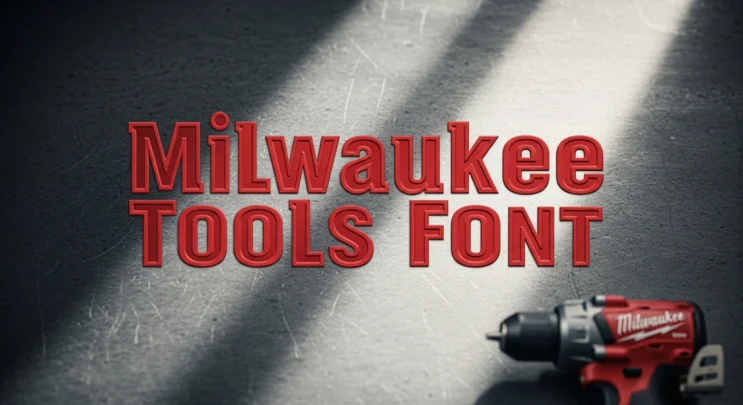
If you’ve ever held a Milwaukee power tool, you already know the feeling the brand is trying to communicate: strength, confidence, and zero tolerance for weakness. What many people don’t notice right away is how much of that attitude comes from typography. The Milwaukee Tools font is not just a logo style. It’s a branding weapon.
In this review, I’ll break down how the Milwaukee Tools font works, why it’s so effective, and what designers can learn from it—through the lens of a US tech blog writer who obsesses over design details just as much as hardware specs.
First Impression: Bold, Loud, and Unapologetic
The Milwaukee Tools font hits you immediately.
It’s bold.
It’s compressed.
And it doesn’t ask for permission.
This typeface is designed to communicate power at a glance. Thick strokes. Sharp angles. Tight spacing. Everything about it says: this tool is built to work, not to look pretty on a shelf.
In a world where many brands soften their logos for digital minimalism, Milwaukee goes the opposite direction. And it works.
Font Style and Structure
The Milwaukee Tools font is a custom, industrial-style sans serif. It’s not publicly released as a standard font family, but its design traits are very clear.
Key characteristics include:
- Heavy weight with strong vertical strokes
- Slightly condensed letterforms
- Sharp corners instead of rounded edges
- High contrast against the red background
There’s no elegance here. No decoration. This font is all muscle.
From a tech branding standpoint, this is exactly the right choice. Power tools are about torque, durability, and reliability. The typography reflects that purpose perfectly.
Readability: Built for Distance and Speed
One of the smartest things about the Milwaukee Tools font is its distance readability.
You can read it:
- On a job site
- On packaging
- On a dusty toolbox
- From across a hardware store aisle
The letters are thick and simple. There’s no visual noise. Even when printed small or stamped on metal, the text holds up.
For industrial and tech brands, this matters. A logo that fails in real-world conditions is a bad logo. Milwaukee clearly tested theirs in tough environments.
Branding Power: Why the Font Works So Well
Let’s be honest. If Milwaukee used a thin, modern font, the brand would collapse overnight.
The font works because it aligns perfectly with the brand promise:
- Professional-grade tools
- No-nonsense engineering
- Built for tradespeople, not hobbyists
Typography is brand psychology. The Milwaukee Tools font tells you who the product is for before you even read the specs.
As a tech writer, I see this as the same principle Apple uses—just executed for a completely different audience. Apple uses clean, calm fonts. Milwaukee uses aggressive, confident ones. Both are correct.
Digital and Print Performance
The Milwaukee font performs well across platforms.
In print:
- Strong contrast
- Clear edges
- Excellent ink hold on packaging
In digital:
- Scales well for websites and apps
- Looks sharp on product listings
- Maintains impact on mobile screens
That said, the font is not designed for body text. And that’s intentional. It’s a display font, not a reading font.
Milwaukee wisely pairs it with simpler, more neutral fonts for instructions, manuals, and websites.
Versatility: Where It Shines—and Where It Doesn’t
The Milwaukee Tools font shines in:
- Logos
- Headlines
- Product branding
- Industrial packaging
It does not work well for:
- Long paragraphs
- UI-heavy dashboards
- Editorial content
- Minimalist designs
And that’s fine. A good font doesn’t need to do everything. It needs to do one job extremely well.
This one does.
Comparison With Other Tool Brand Fonts
Compared to competitors:
- DeWalt uses a more open, blocky font. Strong, but less aggressive.
- Makita leans slightly softer and more rounded.
- Bosch feels more technical and European.
Milwaukee’s font is the most visually aggressive of the bunch. That gives it instant shelf dominance. You notice it first. Every time.
Can Designers Use the Milwaukee Tools Font?
Short answer: not officially.
The Milwaukee Tools font is proprietary. It’s part of their brand identity and not licensed for public or commercial use. Designers looking for similar vibes should search for:
- Industrial sans serif fonts
- Condensed heavy display fonts
- Mechanical or construction-style typefaces
Fonts with strong vertical weight and minimal curves can achieve a similar feel without legal issues.
Final Verdict
The Milwaukee Tools font is a masterclass in brand-aligned typography.
It doesn’t try to be trendy or friendly.
It tries to be strong.
And in the world of tools and industrial tech, that’s exactly what matters.
Rating: ⭐⭐⭐⭐½ (4.5/5)
Best for:
Industrial branding, tools, hardware, construction, power equipment
Not for:
Editorial design, minimalist UI, long-form reading
Closing Thoughts
Great typography doesn’t scream for attention.
It earns it.
The Milwaukee Tools font earns its place by being brutally honest about what the brand stands for. Power. Durability. Confidence. If you’re a designer or brand strategist in the tech or hardware space, this font is a reminder of one simple truth:
The right font doesn’t decorate a product. It defines it.